
Department of Energy
The Department of Energy (DOE) reviews materials submitted as part of the application process, including Current and Pending (Other) Support and in Financial Conflicts of Interest (FCOI) disclosures | FCOI Decision Tool.
Research Security Training
From May 1, 2025 mandatory Research Security Training (Job Aid) is required for all Covered Individuals prior to proposal submission and annually thereafter. Learn more about the DOE requirement.
National Institutes of Health
The National Institutes of Health (NIH) strongly encourages international collaborations. At the same time it requires that all grant-related submissions be true, complete, and accurate and that there is no scientific, budgetary, or effort overlap as well as no unmanaged financial conflict of interest. Learn more on the NIH website.
NIH reviews Biographical Sketches, Current and Pending (Other) Support and Financial Conflicts of Interest (FCOI) disclosures of senior/key personnel related to foreign interference. The NIH uses the Decision Matrix for Assessing Potential Foreign Interference (PDF) for its initial NIH evaluation.
Mandatory Training
NIH will require senior key personnel complete Research Security Training (RST) before submitting applications due on or after May 25, 2026. This requirement can be met by completing one of the options below and will also satisfy the Other Support training requirement.
- Research Security at the University of California (Job Aid)
- NSF Consolidated Research Security Training Module (approx. 1 hour) available on the NSF SECURE Center site
Assessing Foreign Influence
When determining whether mitigation is required, NIH reviews the submitted materials for:
- Participation foreign talent recruitment programs (FTRPs)
- Funding from foreign sources, and
- Affiliations with foreign institutes or entities.
International Collaborations
NIH awards to domestic institutions, such as UCLA, may include foreign components. However, effective May 1, 2025, NIH awards may not include foreign subawards. NIH defines a foreign component as “the performance of any significant scientific element or segment of a project outside of the United States, either by the recipient or by a researcher employed by a foreign organization, whether or not grant funds are expended.” Domestic awards may still include foreign components that do not constitute a foreign subaward.
New International Collaborations Application Structure
For applications due on or after May 1, 2025:
- Foreign collaborators that previously required subawards must now use a new application structure.
- NIH will fund foreign entities directly, rather than through the domestic recipient (NOT-OD-25-104, NOT-OD-25-155).
Key Requirements
- Applicants must use:
Each foreign collaborator must:
- Have its own unique International Project component included in the application. An application that includes multiple foreign collaborators from different institutions must include a separate International Project component for each one.
Minimum Application Requirements
- Overall Component: Describes the project's overall collaborative objectives
- Research Project component: Details the scientific and technical approach
- International Project component: Describes each foreign collaborator's role. the International Project should not be used for:
- Foreign consultants,
- Purchasing equipment or supplies,
- Unfunded collaborations,
- Any activity that would not previously require a foreign subaward.
- Letter of Acknowledgement: From each organization's Authorized Organizational Representative confirming their roles as a direct recipient
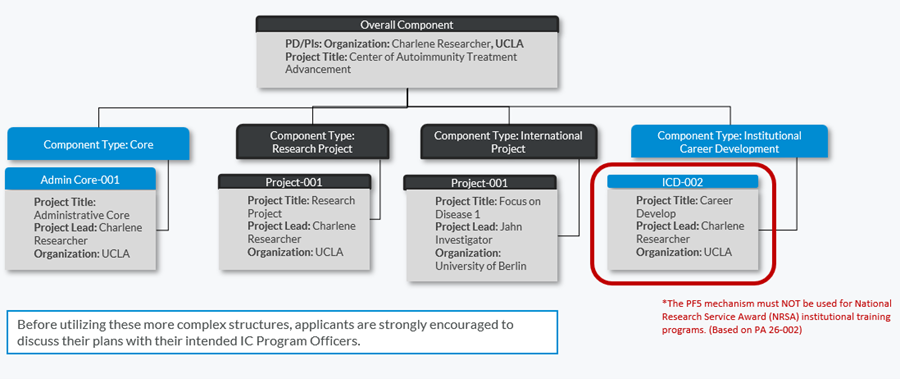
Awards
Domestic and foreign components will be awarded separately, each with their own grant numbers. The domestic organization will be awarded using the PF5 or UF5 activity code, and the foreign organizations using the RF2 or UL2 activity code.
NIH may fund all, some, or none of the components of the PF5 application, based on an assessment of the technical merit, JIT materials, and agency priorities.
Reporting
Each funded organization is responsible for their own financial reporting. Additional guidance on progress reporting and other details will be provided in the Notice of Award.
Foreign Organization Readiness
If selected for funding, foreign organizations must complete the following registrations during the JIT phase:
- System for Award Management (SAM) – SAM registration includes assignment of a Unique Entity Identifier (UEI) number
- eRA Commons – When a foreign organization has an assigned UEI number, they can register with eRA Commons in tandem with completing their Grants.gov registration
- Grants.gov – A SAM registration is required to complete the Grants.gov registration
Foreign organizations are encouraged to begin the required registrations early.
Resources
- NIH Foreign Subaward Policy FAQs
- PA-26-002: NIH Collaborative International Research Project (Parent PF5 Clinical Trial Optional)
- OCGA Hosted Review Session (April 16, 2026) (UCLA Box Login Required)
- NIH Nexus: What Are the Components of a Collaborative International Research Project (PF5) Application and What Should Be Included?
- NIH Collaborative International Research Project (PF5) Video (YouTube)
- NOT-OD-25-104: Updated NIH Policy on Foreign Subawards
- NOT-OD-25-155: New Application Structure for NIH-Funded International Collaborations
- NIH Extramural Nexus: Announcing New Application and Award Structure for NIH-Funded International Collaborations (Replacing Foreign Subawards)
- NIH Collaborative International Research Project (Parent PF5 Clinical Trial Optional)
- OCGA Guide: Determining Whether NIH Prior Approval is Required for a Foreign Component
- UCLA Guidance on the Interim NIH Foreign Subaward Policy: Awards received on/before September 24, 2025 and existing awards with human subjects at foreign sites
National Science Foundation
NSF encourages international collaboration while emphasizing research security. View the Research Security at the National Science Foundation (NSF) for more resources and information, including case studies.
NSF requires senior/key personnel (SKP) to disclose foreign involvement in proposal applications:
- Biographical Sketch,
- Current and Pending (Other) Support),
- Collaborator and Other Affiliations (Table 4), and
- Financial Conflicts of Interest (FCOI) disclosures | FCOI Decision Tool.
SKP must also certify that they are not participating in a malign foreign talent recruitment program.
See Important Notice No. 149: Updates to NSF Research Security Policies for more information.
Research Security Training
From October 10, 2025, mandatory Research Security Training is required for everyone identified as senior key personnel prior to proposal submission an annually thereafter.
This requirement can be met by completing one of the options below.
- Research Security at the University of California (Job Aid)
- NSF Consolidated Research Security Training Module (approx. 1 hour) available on the NSF SECURE Center site